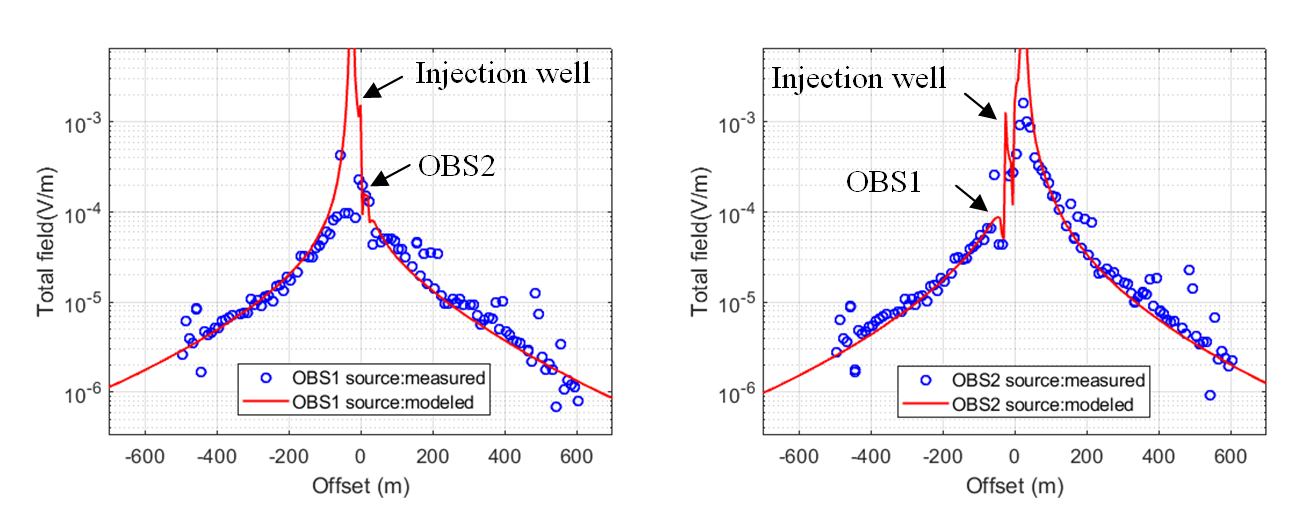
For the model calculation we applied EM3D using completion diagram of CaMI site and a background resistivity consistent with the borehole logs. It was also important to use the accurate position of the return electrode. We note that for the data fit the code also incorporated well casings for well INJ and the other observation well, either OB1 or OB2, in the calculation. In summary, we demonstrate here, for this particular case, that the DC results may be a reasonable approximation to the low frequency EM data collected at CaMI. If this approximation continues to hold, then the extreme computational efficiency offered by the hierarchical modeling used in the DC simulations will permit us to explore far more model complexity, especially the pervasive and troublesome data artifacts that arise when doing EM surveys in mature, culturally developed sites. In Brief, both the low frequency and DC simulation codes provided very consistent results that match the field data really well, indicating their capability to help monitoring borehole integrity with the low frequency EM method.
L o a d i n g
Organization
National Renewable Energy Laboratory (NREL) - view all
Update frequencyunknown
Last updatedlast month
Overview5 hzBorehole logsCMCCaMICanadaDC modelEMEM3DFDEMFEMSandiaWISE-CASINGboreholecasingcontainment and monitoring institutecorrosiondataelectric fieldelectric fieldselectromagneticelectrostatic rsponseenergyexcitationexperimentfieldfield dataforwardfrequency domaingeophysicsgeothermalhierarchical modelingintegritylow frequencylow frequency EM methodmodelingmodellingnumericalpotential fieldsimulatedsimulationvalidationwellwellbore
Additional Information
KeyValue
Dcat Issued2019-04-30T06:00:00Z
Dcat Modified2019-11-20T17:17:20Z
Dcat Publisher NameLawrence Berkeley National Laboratory
Guidhttps://data.openei.org/submissions/7307